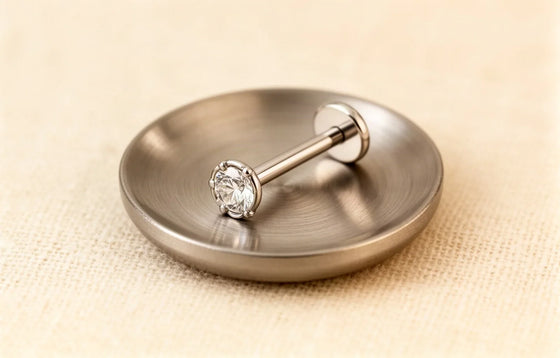
— The guide
Internally Threaded vs Externally Threaded vs Threadless Jewelry
How internally threaded, externally threaded and threadless (push-pin) jewelry work, and which closure suits a fresh piercing.

If you've ever read a product description and wondered what internally threaded vs externally threaded actually means, you're not alone. These terms describe how the decorative end of a piece attaches to its bar, and that small detail matters more than it seems, especially for a fresh piercing. Add threadless, or push-pin, jewelry to the mix and you have the three systems you'll meet almost everywhere. Here's how each one works, why piercers lean towards internal threading and threadless designs for new piercings, how to keep your tops secure, and how to choose for your placement.
Internally threaded vs externally threaded vs threadless: how each one works
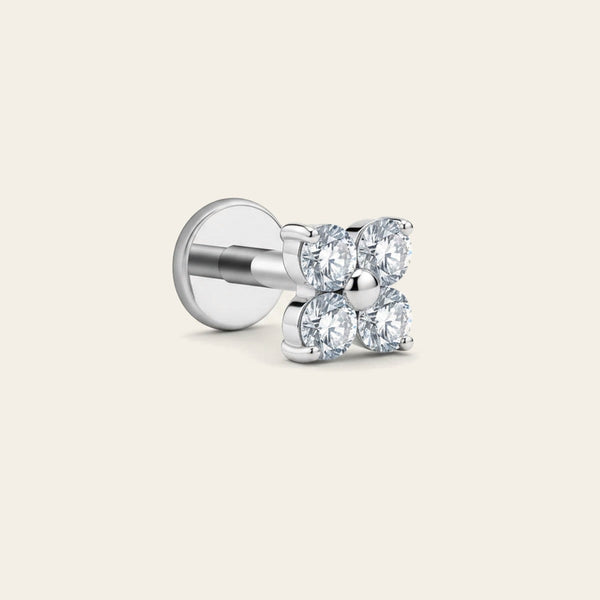
Most piercing studs and barbells have three parts: a bar (or post) that sits in the piercing, a fixed end such as a flat disc or a ball, and a removable end, which is the top, ball or gem you actually see. What changes between the three systems is how that removable end stays on, and which part ends up travelling through your skin.
Externally threaded
The screw thread is cut into the outside of the bar itself, and the ball or top screws onto it. It's the oldest and simplest design, and it's still common in inexpensive jewelry. The catch: every time you put it in or take it out, those little ridges pass through the inside of your piercing.
Internally threaded
Here the end of the bar is hollow, with the thread on the inside. The top carries a short threaded post that screws into the bar. The part that goes through your skin stays completely smooth: the threads only ever meet the other piece of jewelry, never the piercing channel. Many flat back labrets and good-quality barbells are made this way.
Threadless (push-pin)
Threadless piercing jewelry has no screw at all. The top has a thin pin that is slightly bent, and you push it into a hollow post. The bend creates tension against the inside of the post, and that tension holds the top in place. To make it tighter, the pin is bent a little more; to take the top off, you pull it out instead of unscrewing it.
Why internal threading or threadless is preferred for fresh piercings
A new piercing is a fragile tunnel of healing tissue. Anything that rubs or scratches it on the way in or out can irritate it, and irritation is one of the usual reasons behind bumps and slow healing. That's why many professional piercers avoid externally threaded pieces for initial piercings and work with internally threaded or threadless ones instead.
- Smooth on the way in. With internal threading or a push-pin, only a smooth bar passes through the piercing. External threads can catch on the inside of the channel and scrape it.
- No ridges sitting in the skin. Once the jewelry is in, the threads of an externally threaded bar can end up inside or at the edge of the piercing, where they rub every time the jewelry moves.
- An even surface along the bar. On externally threaded pieces the threaded end can be slightly narrower or rougher than the rest of the bar. Internally threaded and threadless bars keep the same smooth surface from end to end.
The closure isn't the only thing that counts, of course: fit, placement and aftercare play a big part too. If you're already dealing with a lump next to the hole, our guide to piercing bumps, keloids and granulomas explains the usual triggers.
Pros and cons at a glance
| Externally threaded | Internally threaded | Threadless | |
|---|---|---|---|
| How the top attaches | Screws onto the bar | Screws into the bar | Pin pushed into the post |
| What passes through the piercing | The threads | A smooth bar | A smooth post |
| Fresh piercings | Usually avoided | Suitable | Suitable |
| Changing the top | Unscrew | Unscrew | Pull out, push in |
| Watch out for | Scratching the channel | Tops working loose over time | Tension too loose or too tight |
Between the two piercer-friendly options, neither is better in every case. Internally threaded pieces feel very secure once they're screwed snug, while push pin jewelry is quick to change and has no thread that can wear out or cross-thread. Plenty of people wear both, depending on the piercing.
How to tighten and check threaded or threadless jewelry
Whatever the system, a top that works loose can fall off and get lost, often in the bed or the shower drain. A quick check every few days is a good habit, and it only takes a few seconds. Always wash your hands first.
- Internally threaded: hold the back or the bar still and turn the top clockwise until it's snug. Remember "righty-tighty, lefty-loosey". Firm finger pressure is enough; never use pliers.
- Threadless: hold the back and gently press the top in until it sits flush with the post. If it slides out too easily, the pin needs a little more bend. Ask your piercer to adjust it rather than forcing the bend yourself.
- Externally threaded: same rule as internal threading, clockwise until snug, without forcing it, so you don't damage the thread.
- Don't over-handle a healing piercing. Checking the top is enough; twisting or turning the jewelry itself isn't needed and can irritate the piercing. Our aftercare guide covers what to do the rest of the time.
Will this top fit my post? Compatibility explained
The three systems aren't interchangeable, and that's the most common surprise when people start mixing pieces from different places.
- Threaded tops only fit bars with the same thread. Thread sizes aren't the same across every brand, and a top that almost fits will either not hold or damage the thread. When in doubt, keep tops and bars from the same maker, or ask your piercer.
- Threadless tops need threadless posts. A push-pin top won't screw into an internally threaded bar, and a threaded top won't stay in a threadless post. Pin and post thicknesses also vary, so they need to match each other.
- Gauge and length still matter. Whatever the closure, the bar has to be the right thickness and length for your piercing. Our piercing gauge and size guide explains the numbers.
Not sure what you're wearing? Look at the end of the bar: visible ridges on the outside mean externally threaded, a hole with a thread inside means internally threaded, and a smooth hollow end with no thread means threadless. Before swapping anything, read our guide on how to change or remove a piercing for timing and hygiene.
Which one to choose by placement
There's no single rule, and your piercer's advice comes first. As a general picture, this is how the three systems usually line up:
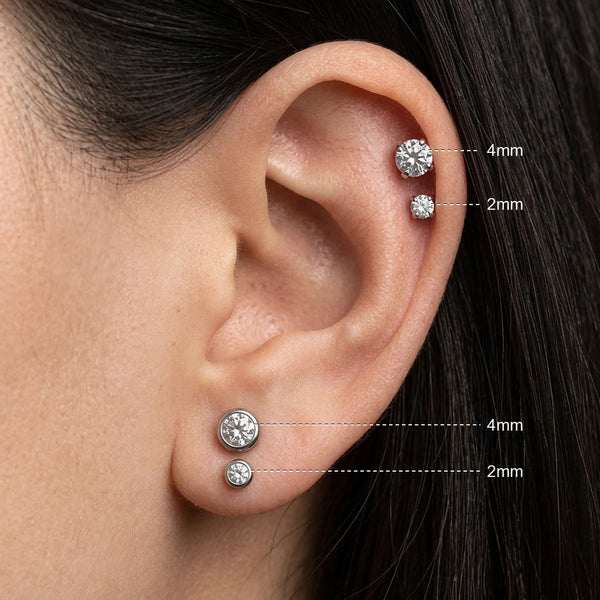
- Lobe and cartilage (helix, tragus, conch, flat): flat back labrets, either internally threaded or threadless. A flat disc at the back is comfortable when you sleep or take phone calls.
- Nostril: flat back studs with an internal thread or a push-pin top are a common choice while the piercing heals. Hoops usually come later, once it has settled.
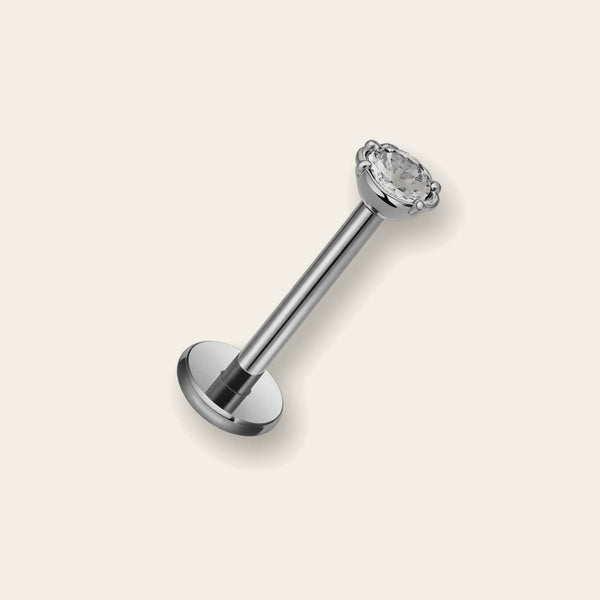
- Lip and labret: a flat back labret keeps a smooth, flat disc against the inside of the lip. Aurea's flat back titanium labrets are internally threaded, with a screw-in top at the front.
- Navel and tongue: barbells for these placements are typically internally threaded, with a ball or gem that screws on.
- Septum and rings: hinged clickers and seamless rings use a different closure altogether, so threading isn't really the question there. Our overview of types of piercing jewelry covers them.
Frequently asked questions
What's the difference between internally and externally threaded?
On externally threaded jewelry, the screw thread is on the outside of the bar, so it passes through the piercing. On internally threaded jewelry, the thread is inside the bar and on the post of the top, so only a smooth bar goes through your skin.
Is threadless better than internally threaded?
Not in every case. Both keep the inside of the piercing smooth. Threadless tops are quick to change and have no thread to wear out; an internally threaded top feels very secure once it's screwed snug. Many piercers use both.
Can I put a threadless top on an internally threaded post?
No. A push-pin top needs a threadless post, and a threaded top needs a bar with a matching thread. If you mix the two systems, the top won't hold.
Does the closure matter more than the material?
Both matter. The closure decides what passes through your piercing; the material decides what your skin is in contact with all day. Implant-grade titanium is a common choice for fresh piercings, and our materials guide explains why.
— Shop this guide


Externally threaded, internally threaded or threadless: the real difference is what touches the inside of your piercing. For a fresh piercing, go for a smooth bar with an internal thread or a push-pin, check your tops every few days, and keep tops and posts from the same system.