— The guide
How to Change or Remove a Piercing (Nose, Ear, Navel)
When to change your piercing, how each type of jewellery opens, and how to put the new piece in without hurting yourself.

Changing your jewellery is the moment a piercing really becomes yours. You just need to wait for the right time and know how your jewellery opens: a labret, a nose screw and a clicker come out in completely different ways. Here's the method, step by step.
When can you change a piercing?
Only once it's fully healed, not when it just looks healed on the surface. Rough guide:
| Placement | Wait at least |
|---|---|
| Earlobe | 6 to 8 weeks |
| Nostril | 2 to 4 months |
| Septum | 2 to 3 months |
| Helix, tragus, conch | 3 to 9 months |
| Daith, rook, industrial | 6 to 9 months |
| Navel, nipple | 6 to 12 months |
| Tongue | 4 to 6 weeks (bar shortened by your piercer first) |
Changing too early is the number one cause of bumps and irritation. If in doubt, have your piercer do the first change. Detailed timings are in our aftercare and healing guide.
Before you start
- Wash your hands thoroughly and work over a clean surface. Plug the sink: small parts fall in fast.
- Clean the new jewellery with sterile saline.
- Check it's the same gauge and a suitable length (see our gauge guide).
- A mirror, good light, and take your time.
How to remove a piercing, by type of jewellery
Threaded jewellery (labret, barbell)
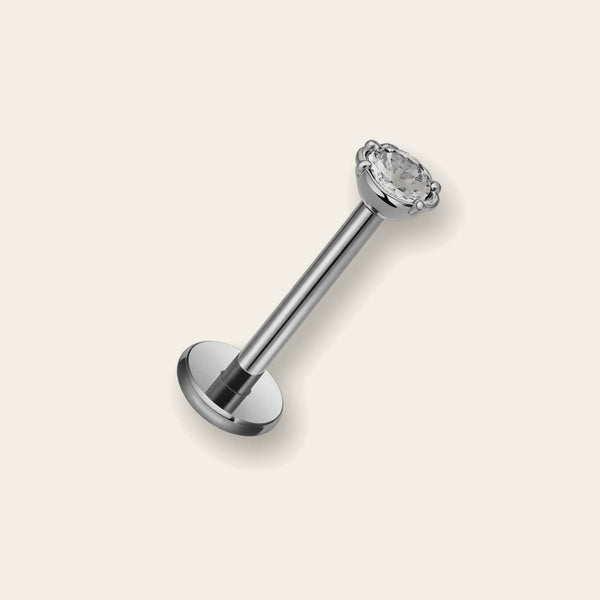
Hold the bar firmly with one hand and unscrew the ball or top with the other, anticlockwise. On a labret, the flat disc stays at the back: it's the front top that unscrews.
Push-pin (threadless) tops
The top is held by the tension of its slightly bent pin. Hold the back disc and pull the top straight out, without twisting. To put it back, push it in until you feel it hold.
Clickers and hinged rings
Gently swing the hinged segment open, slide the ring out of the hole, then close it until it clicks.
Captive bead rings
The bead is held by the ring's tension. Spread the ring very slightly to release it; ring-opening pliers help a lot.
Nose screws and L-shaped pins
A nose screw comes out by turning it along its curve, reversing the way it went in. An L-shaped pin follows its angle: pull gently, then pivot.
How to put the new jewellery in (example: the nose)
- Labret or straight stud: insert the post from inside, then screw or push the top on outside.
- Nose screw: put the tip into the hole from outside, then turn gently along the curve until the top sits in place.
- Ring: open it (clicker or segment), pass it through the hole, close it.
If it resists, don't force it: a little saline on the post helps. If it still won't go, the hole may already have tightened, and a piercer can reopen it cleanly with an insertion taper.
How fast does a piercing close?
It depends on its age. A fresh piercing can start closing within hours. An old, well-healed one can stay open for days, or never fully close. Nose and cartilage piercings tighten quickly, so don't leave them empty for long.
Frequently asked questions
How do you take out a nose piercing?
First identify the type: a labret unscrews or pulls off at the front, a nose screw comes out by turning along its curve, a ring opens at its segment. Clean hands, slow movements, no forcing.
Can I change my first jewellery myself?
Yes, once the piercing is fully healed. For the very first change, especially on cartilage, tongue or navel, going to your piercer is safer.
When can I change my helix piercing?
Not before 3 to 6 months at the very least, often longer. A helix that still crusts or swells when you sleep on it isn't ready.
What jewellery should I replace it with?
The same gauge, a suitable length and a material your skin tolerates: ASTM F136 (G23) titanium or solid gold. A flat-back labret is the most comfortable day to day.
Changing a nose piercing? Our step-by-step guide on how to put in a nose ring covers every closure, from L-shapes to clickers. And if you are unsure how your jewellery opens, read internally threaded vs threadless.
— Shop this guide




Changing your jewellery well is mostly about waiting for the right moment and going gently. The rest is the fun of styling.