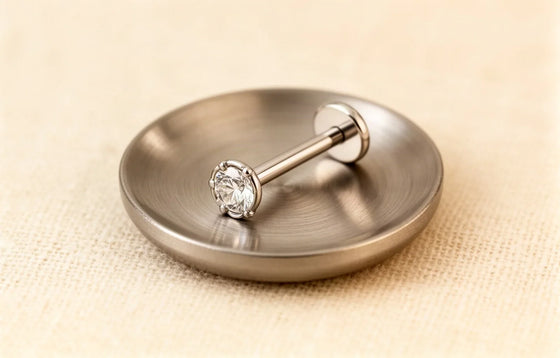
— The guide
MRI with Piercings: What to Know Before Your Scan
Getting an MRI with piercings: why metal matters, what titanium changes, and how to prepare. The imaging team always decides.

Booked for a scan and wondering about an MRI with piercings? You're not alone: it's one of the first questions people with several earrings, a nose stud or a septum ring ask when the appointment letter arrives. The short answer is that metal and MRI scanners don't mix freely, so the imaging team will want to know about every piece of jewellery you wear, and in many cases they'll ask you to take it out. Here's why metal matters, what titanium does and doesn't change, and how to prepare without losing a piercing you love.
Can you get an MRI with piercings?
It depends on the imaging centre, the type of scan, the part of the body being examined and the jewellery itself — and that decision belongs to the medical team, not to you or your piercer. Many centres simply ask everyone to remove all metal jewellery before entering the scanner room, piercings included. Others assess each situation individually. One thing is the same everywhere: you need to tell them, ideally when you book and again on the day.
So if you're asking "can you have piercings in an MRI?", the honest answer is: only if the radiology team says so. This guide explains the reasons behind their questions, so you can arrive prepared and avoid last-minute stress.
Why metal matters in an MRI scanner
An MRI (magnetic resonance imaging) scanner uses a very strong magnet and radio waves to create detailed images of the inside of the body. That's what makes it so useful, and also why staff take metal seriously. Three concerns come up most often.
- Magnetic pull. Some metals, called ferromagnetic, are attracted by the magnet. A piece of jewellery containing them can be pulled or tugged, which is the last thing you want on a piercing.
- Heating. The radio waves used during the scan can warm some metal objects, particularly ones in contact with the skin. That's one reason staff ask about rings, hoops and anything that forms a loop.
- Image artefacts. Metal can blur or distort the picture around it. Even a small stud close to the area being scanned may hide exactly what the doctor needs to see.
How much each of these matters depends on the metal, the shape and size of the jewellery, where it sits and the scanner being used. That's specialised knowledge, and it's precisely why the call belongs to the imaging team.
Is titanium jewellery safe for an MRI?
Implant-grade titanium (ASTM F136) is not ferromagnetic, so it isn't attracted by the magnet the way some steels or nickel-containing alloys can be. That's a real difference, and it's one of the reasons titanium is used in medicine. But "not magnetic" doesn't automatically mean "fine to keep in": titanium jewellery can still affect the image, and the team may have other concerns depending on the scan.
Aurea's jewellery is made from implant-grade titanium, and we still won't tell you it's "MRI safe": no jewellery brand can make that call for your exam. Our piercing materials guide explains the differences between titanium, steel and other metals if you want to know exactly what you're wearing.
Two things make the conversation with staff easier:
- Know what your jewellery is made of. "Implant-grade titanium" or "surgical steel" is more useful than "silver-coloured". If you're not sure what kind of piece you have, our guide to types of piercing jewellery helps you name it.
- Mention finishes and stones. A PVD gold finish, crystals or decorative ends can involve different materials from the bar itself, so say so.
MRI, X-ray, CT and surgery: what changes
Piercings come up for other procedures too, for different reasons. The table gives a general idea only; the instructions you receive always take priority.
| Procedure | Why jewellery matters | What to expect |
|---|---|---|
| MRI | Strong magnet and radio waves | Often asked to remove all metal jewellery |
| X-ray | Metal shows up on the image | Possibly asked to remove jewellery near the area |
| CT scan | Metal can disturb the image | Possibly asked to remove jewellery near the area |
| Surgery | Safety in the operating room | Often asked to remove jewellery: ask in advance |
X-rays and CT scans don't use a magnet, so the concern there is mainly the quality of the picture. Before surgery, the reasons vary: the equipment used during the operation, possible swelling, or access to the mouth and airway for oral piercings, among others. Whatever the procedure, ask the team as soon as you have a date, so you have time to plan.
How to prepare for an MRI with piercings
- Tell them when you book. List every piercing, including the ones people forget: navel, nipples, genitals, tongue, the back of the ear.
- Ask what they want you to do. Remove everything? Only jewellery near the area being scanned? Are non-metal retainers accepted? Get the answer before the day.
- Practise taking your jewellery out. If you've never removed a piece yourself, try a few days before, not in the changing room. Our guide on how to change or remove a piercing walks you through threaded, threadless and clicker jewellery.
- Bring a small case. A clean pouch or box keeps everything together, including tiny ends and backs that are easy to lose.
- Be honest on the day. Staff usually go through a safety questionnaire with you. Mention any jewellery you couldn't remove, rather than hoping it won't matter.
Your options if you don't want the hole to close
The worry is understandable: some piercings tighten quickly once they're empty. Depending on your situation, there are a few options to discuss with the imaging centre and your piercer.
Healed piercings: remove, then reinsert
For a well-healed piercing, taking the jewellery out for the duration of the exam is often all it takes. Some holes, such as certain nose or cartilage piercings, can tighten faster than you'd expect, so put the jewellery back in as soon as you're allowed, with clean hands. If it resists, don't force it: a piercer can help.
Non-metal retainers
Retainers in glass, PTFE or bioplast exist precisely to hold a piercing open without metal. Some imaging centres accept them; others prefer nothing at all in the piercing. Ask first, and declare them even though they aren't metal. A piercer can help you choose the right size and fit it, especially for a piercing you've never changed yourself. Our gauge and size guide helps you note your current measurements beforehand.
Fresh or still-healing piercings
A piercing that's only a few weeks old is the trickiest case: removing the jewellery can be difficult, the hole may close fast, and reinserting it can irritate the healing channel. Tell the imaging centre early that the piercing is recent, and talk to your piercer as soon as you know the date. Together you can see what's possible: a non-metal retainer, a visit to remove and refit the jewellery, or, if the exam is planned well ahead, waiting until afterwards to get a new piercing. After the scan, go back to your usual aftercare routine.
What if a piercing won't come out?
Sometimes a ring is stuck, a ball is screwed on too tight or a piercing is too fresh to open. Don't reach for pliers or force it at the last minute: you risk injuring the piercing. Tell the centre in advance, and ask a professional piercer, who can usually remove or swap jewellery safely. If you notice redness, heat, swelling or discharge around a piercing before or after the exam, our guide to infected piercing signs helps you know when to see a doctor.
Frequently asked questions
Do I have to take out my piercings for an MRI?
Often, yes. Many imaging centres ask for all metal jewellery to be removed, and others look at each case. Only the team doing your scan can tell you, so ask when you book.
Is titanium jewellery magnetic?
Implant-grade titanium isn't ferromagnetic, so it isn't attracted by the magnet like some steels. It can still affect the images, and the decision to keep it in stays with the radiology team.
Can I wear a glass or plastic retainer during an MRI?
Sometimes. Glass, PTFE and bioplast retainers contain no metal, and some centres accept them, while others prefer an empty piercing. Ask beforehand and mention them on the day.
Will my piercing close during the scan?
A well-healed piercing often stays open for the time of an exam, but some holes tighten quickly, especially fresh ones and some nose or cartilage piercings. Put your jewellery back in as soon as you're allowed, and ask a piercer if it won't go back in.
Do I need to remove piercings for an X-ray or CT scan?
Not always, but you may be asked to remove jewellery near the area being imaged, because metal shows up on the picture. Follow the instructions you're given.
— Shop this guide



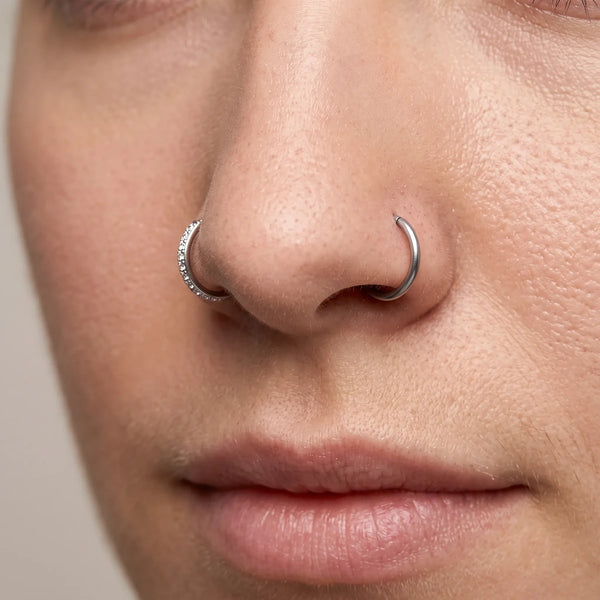
An MRI with piercings is mostly a question of communication. Declare every piece of jewellery, ask what the centre expects, prepare your removal or retainer plan ahead of time, and follow the team's instructions on the day. A piercing can always be sorted out afterwards with a piercer's help; the scan is what matters in the moment.